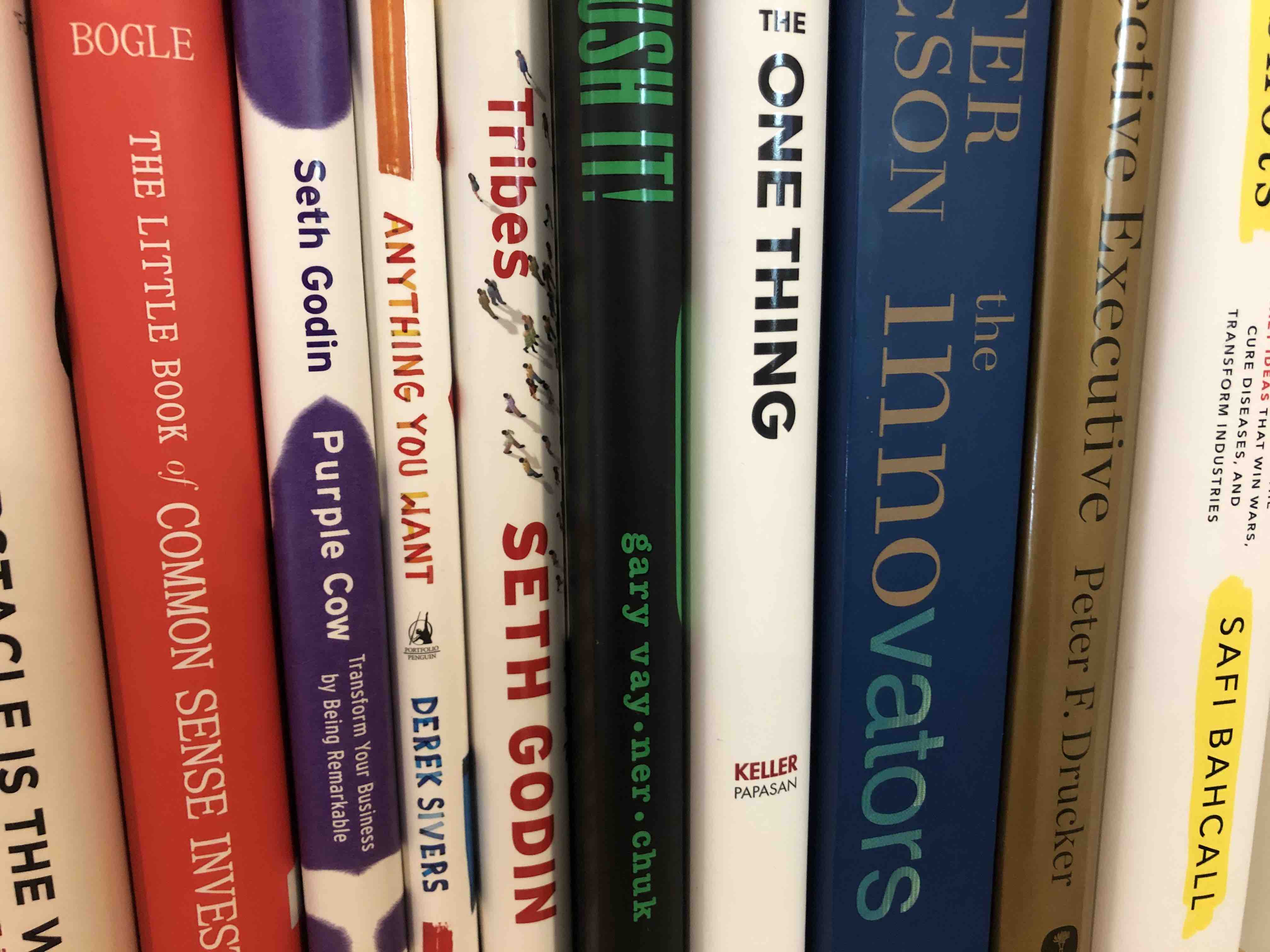
I recently started listening to the podcast Founders.
Each week, David Senra reads a biography of one of history’s greatest minds (while he covers most modern-day entrepreneurs like James Dyson, Steve Jobs, Michael Dell, etc., he also covers Napoleon, Benjamin Franklin, Churchill, etc. ).
I have ripped through 100s of these episodes in the last month. I just love em!
It has reminded me how much I not only love biographies and learning lessons from great entrepreneurs, but also just how much I don’t know.
It’s always good to remember this lesson, because none of us should ever stop learning — and while Founders is an amazing way to do it, this article is more about what it inspired.
Here are the key principles I’ve pulled from the podcast — and from my own experience building and selling a company:
1. Bet on Yourself
If you can’t bet on yourself, who will?
Often, no one will get what you are doing or why.
I know when I left my secure job to go work part-time for not one, but TWO startups, everyone thought I was insane.
“Whether you think you can or you think you can’t, you’re right.”
— Henry Ford
But I had extreme passion for one of the companies, and more importantly, passion for what I would be doing every day for both startups.
You can’t fake that, and you can’t take it away.
In the end, I bet on myself, and it worked out.
If your gut is telling you to do it — trust it and make the bet on yourself.
2. Be Insanely Enthusiastic About Your Idea
This one is pretty self-explanatory, but if you aren’t insanely enthusiastic about your idea, don’t do it!
When you start a business, you are committing to decades (see below) — therefore, you MUST really love what you are doing.
But it goes beyond that. How are you going to solve the thousands of problems that will crop up around you as you build a business if you don’t love that business?
“People who are crazy enough to think they can change the world are the ones who do.”
— Steve Jobs
You should obsess over it.
Ideas should pop into your head when you’re in the shower, driving, or even sitting on the toilet.
If you’re not enthusiastic about your business, then it won’t be a success.
You will get punched in the mouth, you will need to pivot, and if you don’t have an extreme obsession for what you are doing, it won’t last.
Now that doesn’t mean you will wake up every day and feel jazzed about your idea 24/7. Nope.
You’ll still have many self-doubt moments.
But starting from an enthusiastic foundation will help you to overcome the doubts, the naysayers, and, more importantly, provide you with the grit to just keep going.
3. Build a Business That is Authentic to You
I knew from the moment I was entertaining a business career that a standard corporate job would never work for me.
I am a shorts and t-shirt kind of guy, and nothing is going to stop that.
“To be yourself in a world that is constantly trying to make you something else is the greatest accomplishment.”
— Ralph Waldo Emerson
And so you must build a business that is authentic to you.
If you are an intense, on all the time type of person, then you must embrace that and build it into your business.
Or if you want to spend most of your time reading like Charlie Munger and Warren Buffett, then you can and should build a business that allows you to do that.
Build a business (and a life, for that matter) that is authentic to you!
4. It Takes Years, Not Months
This one is pretty simple, but it is also the foundation for building a great business.
Focus on ONE thing and do it for a damn long time.
The media likes to make everything seem sexy. The dream that is sold is that you start a company, work hard for a bit, build a product that people love, and you sell it for millions a year later.
Doesn’t happen.
“Take a simple idea and take it seriously“
Charlie Munger
In my own personal experience, our company was very lucky to be in the right place at the right time, but even then, it took 5 years to grow and sell our business, and we still would have been better off continuing to run it to this day.
Building great businesses takes time. Way more time than you think.
James Dyson spent 15 years creating 5,127 prototypes before finally developing the world’s first bagless vacuum cleaner.
And what about someone like Albert Einstein, who said, “It’s not that I’m so smart, it’s just that I stay with problems longer.”
The moral of the story is, when you start a business, expect to be in it for decades, not years (you will also make more money this way too).
5. Focus on the Problem, Not the Solution
When starting a company, your focus should be entirely on solving a problem.
The exact solution doesn’t matter — because it will almost certainly change.
Look at Phil Knight, the founder of Nike, for example….
When he first started Nike, it wasn’t even called Nike, but Blue Ribbon Sports, and it started out by importing (and selling) Onitsuka Tiger running shoes from Japan to the US.
“We wanted to make the best running shoes in the world. We wanted to make products that helped athletes run faster and farther.”
— Phil Knight, Shoe Dog
But he ran into problem after problem with the Japanese distributors who were either late with their shipments, wrong with their shipments, or flat out refusing to grant him rights to certain markets. Not to mention, they weren’t integrating Phil’s suggested changes into the product
It was clear after dealing with issue after issue that he would need to create his own brand, and thus Nike was born.
The problem Phil Knight was solving for was to create running shoes that performed better. How he solved this problem ultimately changed over time.
In other words, don’t be afraid to pivot!
6. Control, Control, Control
Phil Knight’s issues outline exactly why it is so important to not only be flexible and be ready to pivot, but also why you must seize control of any issues that arise in your business.
And one of the first big issues that will arise is ownership of your business.
You must own a majority stake in your business.
Do not give equity for capital, unless you absolutely must.
I know this is counterintuitive to how most businesses are built these days, but if you want to truly control your own destiny without naysayers, you need that control.
“Control your own destiny or someone else will.”
— Jack Welch
I learned this firsthand at my last company. I did not have complete control — I joined the two co-founders as the third person on board, and I had only a minority stake.
When my business partners wanted to sell, they could sell, and there was nothing I could do about it.
In the end, my business partners controlled my destiny, not me, and their decision led me to work in corporate America for 5 years before finally calling it quits.
But if they hadn’t decided for me? I probably wouldn’t be accidentally retired; I would still be working on that business!
7. Strive for Excellence: Never Stop Improving
Your first product won’t be the best one. Not your second either.
Keep going.
“Perfection is not attainable, but if we chase perfection we can catch excellence.”
— Vince Lombardi
Remember how James Dyson made 5,127 prototypes before he was able to go to market with his vacuum cleaner?
Or what about Walt Disney or Steve Jobs? They were both constantly pushing the boundaries of what excellence could be in movies, computers, mobile phones, and theme parks.
Continuous improvement wins in the long run.
There is no such thing as perfect, but that doesn’t mean you should never stop improving.
Again, you are in this for decades, not years.
8. Practice Ruthless Cost Discipline
Just like how you need to have control of your business’s ownership, you must control its costs.
Invest heavily in what works, cut back what doesn’t.
Ultimately, it is uncontrolled costs that take down more businesses than anything else.
“Beware of little expenses; a small leak will sink a great ship.”
— Benjamin Franklin
I saw this firsthand in corporate America after one of my companies was acquired. There was a brand owned by our parent company that was on the decline, and its expense sheets were accidentally sent to me.
I was shocked to find a $50,000 dinner for 10 people on the expense sheet.
Their brand was in tatters, and yet they spent an entire entry-level salary on a dinner?
Bloat sinks boats.
The greatest founders understand this and control costs with an iron fist.
I saw this firsthand. Most of the startups in my space came in hot with millions in funding — but a few short years later, their doors were shuttered. They couldn’t make a profit. They didn’t control their costs!
My company outlasted them, and we reaped the rewards.
9. Simplify. Simplify. Simplify.
This ties in with the above, but I think it needs to be in there twice for emphasis.
Keep simplifying your processes, products, and costs.
You can never be complacent. You must fight complacency at all costs.
“It’s kind of like leaving a weed. If you don’t remove the roots of the weed, then [it’s] easy for the weed to grow back“
— Elon Musk
Elon Musk has an aggressive bias for continuously deleting processes, parts, and even entire departments.
He says, “If you’re not adding things back in at least 10% of the time, you’re clearly not deleting enough.”
10. Hire ONLY A-Players
Of course, everyone wants to hire only A-players, but it makes a bigger difference than you will ever think.
Elon Musk famously interviewed the first 3,000 SpaceX employees. 3K!
If that doesn’t alone show you how valuable hiring people is, then I don’t know what does.
“I consider the most important job of someone like myself [to be] recruiting.”
— Steve Jobs
I also know firsthand how making bad hires can tank the motivation of others in the company.
Your organization will only perform to the least productive employee.
Hire slowly. Fire fast.
But make sure they are the damn best talent you can get your hands on.
11. Pay Top Dollar for Top Talent
Do you want to get a 50x return on your best hires? Then you must secure great talent at any cost.
That is exactly why Meta is offering compensation packages, including up to $200 million, to attract top AI talent.
It is worth that much to them to stay in the game. The top talent is worth that 50x return on investment.
“If you think hiring professionals is expensive, try hiring amateurs.”
— Red Adair
For me personally, I found that it was the top 2-3 engineering employees who made the most impact on our tech. Those guys and gals were worth every damn penny.
**But a caveat here is that you don’t always have to pay like crazy….
In many cases, when what you are doing is so unique and original, it is better to hire young and train from the ground up. **
12. Bias Toward Action (Speed Wins)
And finally, you must have a bias toward action.
In the end, I really believe that the distinction between winners and losers in business is action.
There is always something you can do.
There is always some action you can take.
It might not always be the right action, but even a wrong turn will teach you a lesson.
I believe it was my bias toward action that helped get me to where I am today.
“Ready, fire, aim.”
— Sam Walton
My buddy would say to me, “Wouldn’t it be great if we could build a website that does…” – and I would just go out there and figure out how to do it.
When we first started, I had no idea how to code, but I wanted to build that website.
So I found the one person I knew who did, and I convinced him to build me a website for free.
But when he couldn’t find the time to complete it, I had to take it over.
I taught myself to code.
I kept solving problem after problem.
And one thing led to another.
Bias toward action is key!
BONUS: Perfection Not Required
You will make many mistakes along the way.
That is just part of the game.
“Success is stumbling from failure to failure with no loss of enthusiasm.“
— Winston Churchill
Starting a company takes guts. It takes passion. It takes vision.
And it takes years to get it right.
In the end, the difference between the winners and the losers is simply that the losers quit.
So don’t quit!
Remember
Building something great takes decades, not days.
The founders who win aren’t the smartest — they’re the ones who stay in the game longest.
Doing all of the above isn’t easy. It’s a long, hard road. One that you’ll be on most likely by yourself.
But building a business that employs other people and creates something is a great way to live.
In the end, I want to live a life I’m proud of — and building a business that could thrive without me was a big part of that. What about you?
This post was inspired by the podcast Founders. Many of the headings are directly called out by David, and I simply pulled them together into a digestible post. I highly recommend you give it a listen if you are into biographies and/or business. You won’t regret it.